If you're familiar with evangelism tools, you may think of handing out gospel tracts or using methods to walk someone through the gospel, like the 3 Circles and the Bridge Diagram. But what if there’s a type of tool we haven’t considered? An old adage says, “Talk to God about people before you talk to people about God.” Prayer is the single most important component of our witness to the lost; after all, it’s God doing the saving work… not us. If that’s the case, why don’t we have more techniques to actually pray for our lost friends?
Conversation Quadrants provides just that! By using a simple chart to track the types of conversations we've had with different lost people, we create a tool for prayer. The visual provides a quick guide for our prayers and those of our faith family praying with us, all for the salvation of the lost people in our lives!
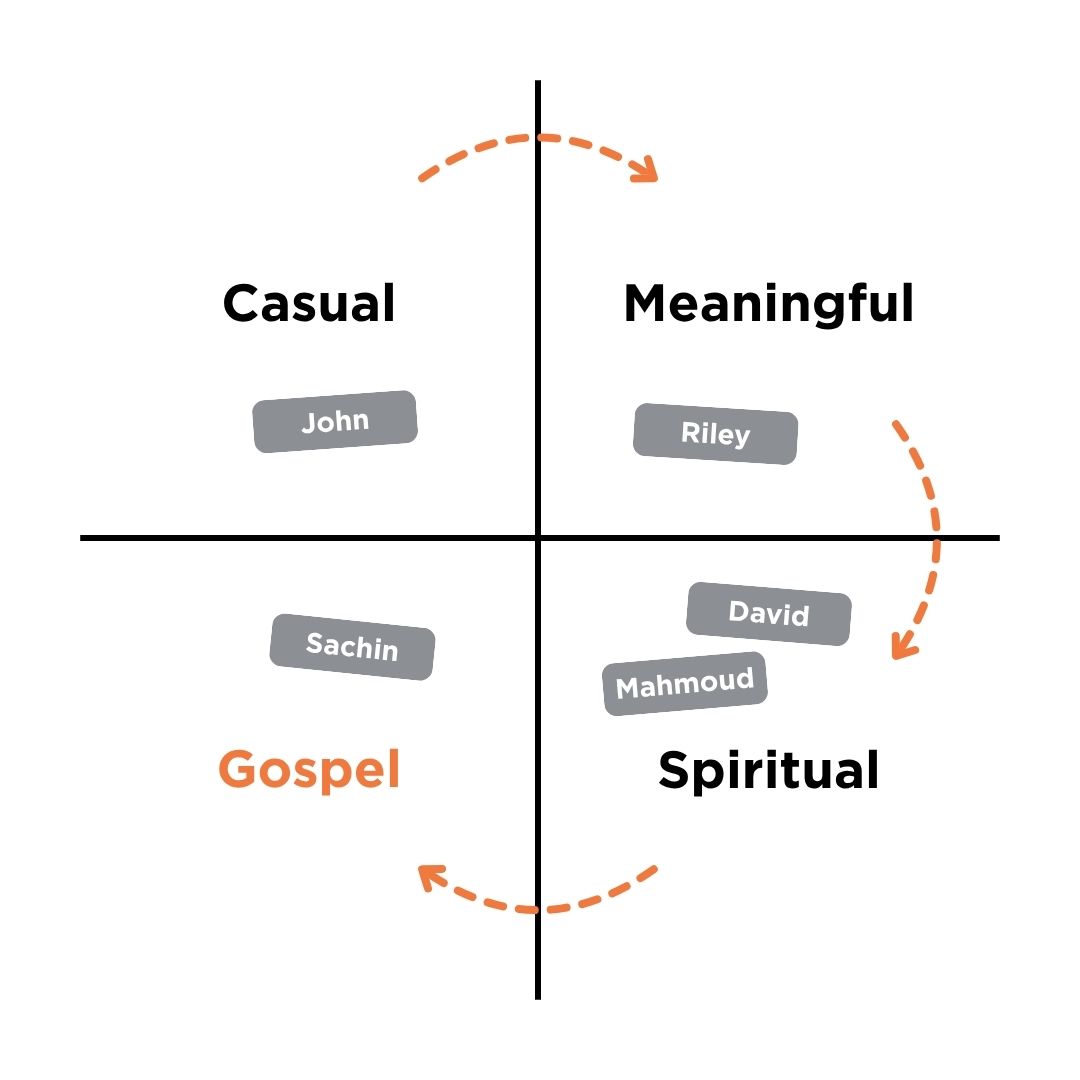
Casual Conversations
A casual conversation is the type we generally start with. It takes no vulnerability and is often where people feel most comfortable. These are probably most of the conversations you have with coworkers, neighbors, store employees, etc. Simple banter like, “It sure has been *INSERT CURRENT WEATHER* lately, hasn’t it?” or “How ’bout those *INSERT SPORTS TEAM*!” While it’s fine to greet people and have casual conversations, as the Christian in the conversation, it should be our aim to go below the surface. We should aim to have meaningful conversations.
Meaningful Conversations
A meaningful conversation is anything that goes deeper than surface level. This could be a discussion about how family life is or how work is going. Or it could be really getting to know each other over a meal or coffee break. It’s simply asking the next-level question so that the relationship doesn’t stay superficial.
Spiritual Conversations
As we have meaningful conversations, we’re going to be listening intently for opportunities to take the conversation to the spiritual level. This could be as simple as offering to pray when they share something hard about work or home life. Or it might just involve being “conspicuously spiritual,” sharing something you learned from church when they ask how your weekend was. The aim is to get to know them and their spiritual beliefs while also sharing some about yours. This is a chance to test their openness to hearing more spiritual things, including the gospel.
Gospel Conversations
While we don’t want to turn this friendship into a project, as a believer who desperately wants to see this friend saved, your aim in all of this is to get to gospel conversations. As it’s becoming normal to discuss spiritual things, there should be opportunities for you to share what you believe most deeply (i.e., the death of Christ for your sins and the resurrection of Christ that you might have new, eternal life in him). Sometimes this could look like sharing your story of salvation with a clear emphasis on the gospel at the inflection point in your life. Or it may be through one of the gospel-sharing tools mentioned above. Whatever form it takes, our prayer and desire should be to share the gospel with this friend and invite them into knowing, loving, obeying, and worshiping Jesus as their God.
Put It Into Practice
Now that we understand the basics of Conversation Quadrants, it’s time to put it to use! Start by drawing your X and Y axes and labeling each of the quadrants as above. Then, think of three lost friends in your life and what types of conversations you’ve tended to have in the past. Write their names in the associated quadrant. Now, spend a few minutes praying that God would open a door for you to have the next type of conversation. For example, “God, thank you that I’ve been able to have more meaningful conversations with Riley lately. I pray that you would give us an opportunity to slow down and talk again during work this week and that you would give me the boldness to have a spiritual conversation with him. Amen.” Pause and pray over this now…. Did you actually pause and pray? There’s still time; this article isn’t going anywhere.
In addition to your own prayers for your friend, you can invite other believers in your life to join in praying, too! It often feels like we give an all-or-nothing prayer request: “Please pray for Riley’s salvation.” And while we should pray big prayers, it can be helpful to pray for specific steps along the way toward their salvation. Message a connection group member now to ask them to pray for an opportunity with a friend based on your Conversation Quadrant.
The Tool In Use
Here is a hypothetical example: Riley is a colleague at work. You’ve often chit-chatted over sports, the weather, and work. You noticed that Riley got really upset in a meeting earlier in the day. You see that he’s alone later, so you approach him and gently ask, “Are you doing all right, Riley? I noticed that meeting got a little heated.” He may be taken aback that you said anything or even noticed, but he will likely be very grateful that someone cares. He may even open up about what’s frustrating him under the surface. This is a meaningful conversation! If this is where the conversation ends, this would be a great time to write “RILEY” down in your meaningful quadrant and invite members of your connection group to pray for a future spiritual conversation with Riley.
Or perhaps you take it a step further: you offer to pray over the things he shared, to which he responds, “Of course.” As you lift these prayers up, you’ve now set the precedent that it’s okay in this relationship to address deeper matters and spiritual things, as well as that you have a habit of going to God on others’ behalf. You’ve had a spiritual conversation! This would be a great time to text your connection group and ask for prayers for another future spiritual conversation with Riley where you are able to understand more of what he believes and share more of what you believe.
Equipped with the prayers of the saints, the next day, you boldly invite Riley to take a quick lunch break with you. It’s odd in your company culture, but you’re really trying to set the example that people matter. He agrees, and you head to the cafeteria with your own lunches. Over what you thought would be a 15–20-minute meal, Riley opens up more deeply about what he’s been struggling with. You’re able to pray again and then share a story of a similar struggle you had. Perhaps you even use that hardship as a springboard to share about your life before Jesus, how you met Jesus, and how he’s brought forgiveness and healing through his death, burial, and resurrection. Now you’ve had a gospel conversation! When you get home, you excitedly update your Conversation Quadrant and eagerly text your connection group, inviting them to pray for future gospel opportunities with Riley.
Over the next weeks and months, you and Riley make a habit of getting lunch together and even reading the Bible each week, walking through the Gospel of John. You’re able to share truths about Jesus over and over, and Riley seems to be warm to them. You invite three men in your connection group to join you in praying daily for Riley’s salvation, and they commit alongside you. As you plead for Riley’s salvation and for future gospel conversations, the Lord grants the request. As you read through John 14:6, Riley realizes that he had been trying to get to God on his own all along and confesses that he needs Christ. You’re able to pray together as Riley confesses his sins, his need for a savior, and his trust in Christ for that salvation. You praise God together for his grace and mercy and make plans to continue walking through the Gospel of John. He also agrees to start joining you for church each week. You enthusiastically text your connection group, thanking them for their faithful prayers and letting them know that they have gained another brother in Christ!
Following the steps above, revisit your Conversation Quadrant from earlier. If you haven’t already, take a picture of your Conversation Quadrant and share it with your connection group or another believing friend. Once you’ve had a deeper conversation with a given unbelieving friend, update your quadrant and share it with your believing friends so they can continue praying!
By simply keeping track of the types of conversations we’ve had, Conversation Quadrants gives us a helpful tool to pray faithfully for the salvation of those in our lives. It motivates us to seek out deeper conversations with lost friends, challenges us to pray for their souls, and invites others to pray alongside us. And one day, Lord willing, when we look back at those names that moved from quadrant to quadrant, we'll see not just the conversations we tracked, but brothers and sisters the Lord drew to himself through our simple, faithful obedience to pray and pursue people for the sake of the gospel.